


Your office looks fine on Monday morning. By Thursday the kitchen bin is overflowing, the meeting room glass is covered in fingerprints, and someone has left a coffee ring on the boardroom table that nobody will own up to. The gap between “cleaned” and “actually clean” is almost always a missing checklist, not a lazy cleaner.
A written office cleaning checklist is what turns a vague cleaning arrangement into a service you can measure. It tells your cleaner exactly what happens every night, what happens once a week, and what only needs attention monthly — so nothing gets quietly dropped. If you are reviewing your current arrangement or comparing quotes for office cleaning in Melbourne, this is the document to build first.
Want a free on-site walkthrough and a fixed quote for your office? Call 0404 352 582 or request a free quote online — same-day response during business hours.
Why a written cleaning checklist matters for Melbourne offices in 2026
- It is a workplace safety obligation, not just housekeeping. Under Victorian law, employers must provide clean toilets, hand washing facilities and a hygienic place to eat. WorkSafe Victoria’s Workplace facilities and the working environment compliance code sets out what “adequate” actually looks like, including cleaning and maintenance schedules.
- Hybrid work has changed usage patterns. Most Melbourne offices are now busiest Tuesday to Thursday. Cleaning five nights a week at the same intensity wastes money; cleaning to the same schedule as 2019 usually means peak days are under-serviced.
- Contract disputes almost always start with scope. When a client says “they missed the kitchen again,” the real issue is that the kitchen was never listed as a daily task in writing.
- Hygiene is visible to clients. A smeared entry door and a dusty reception counter are the first two things a visitor sees, and both take under five minutes a day to prevent.
- Consistency is cheaper than recovery. Carpet that is vacuumed properly every night needs extract cleaning far less often than carpet that is skipped twice a week.
If any of these sound familiar, the fix is rarely a new cleaning company. It is a clearer scope.
What an office cleaning checklist actually covers
An office cleaning checklist is a task list split by frequency — daily, weekly, monthly and periodic — and by zone. The four zones in almost every Melbourne office are reception and entry, workstations and open plan, meeting rooms, and wet areas (kitchen, bathrooms, end-of-trip facilities).
Two terms worth clarifying before you write yours. Scope of works is the full task list attached to your cleaning agreement — it is the contractual version of the checklist. Periodic works are the tasks priced separately from the nightly rate, such as carpet extraction, window cleaning and hard floor restoration. Most disagreements between businesses and their commercial cleaning provider come from periodic works being assumed to be included when they were quoted separately.
A good checklist names the task, the frequency, and the zone. “Clean kitchen” is not a task. “Wipe and sanitise kitchen benchtops, sink and tap fittings — daily” is.
1. Daily office cleaning tasks
These are the non-negotiables. They take a two-person team roughly 45–90 minutes in a typical 20-person Melbourne office.
- Empty all general waste, recycling and kitchen bins; replace liners
- Wipe and sanitise kitchen benchtops, sink, tap fittings and appliance exteriors (microwave, fridge handles, coffee machine)
- Clean and disinfect all toilets, urinals, basins and tap fittings
- Restock consumables: toilet paper, hand soap, paper towel, sanitiser
- Mop hard floors in kitchen and bathroom areas
- Vacuum all carpeted traffic areas and entry matting
- Spot-clean fingerprints from entry doors, glass partitions and light switches
- Wipe reception counter and reset the waiting area
- Clear and wipe meeting room tables; reset chairs
High-touch points to name explicitly
Door handles, lift buttons, shared keyboards, printer touchscreens, kitchen tap handles and bathroom door pulls. These get skipped constantly because they are not obvious surfaces. Listing them individually is the only reliable fix.
2. Weekly office cleaning tasks
- Vacuum the full floor area, including under desks and along skirting boards
- Damp-wipe all desks and workstation surfaces (with a clear-desk policy on the nominated night)
- Dust window sills, ledges, shelving and the tops of filing cabinets
- Clean internal glass doors and partitions fully, not just spot-clean
- Descale bathroom fixtures and clean mirrors edge to edge
- Clean the inside of the microwave and wipe out the fridge
- Detail-clean bin surrounds and sanitise bin lids
- Wipe skirting boards and door frames in high-traffic corridors
3. Monthly office cleaning tasks
- Dust high surfaces: air-conditioning vents, light fittings, ceiling fans, cable trays
- Clean and sanitise waste bins inside and out
- Spot-clean walls and door faces for scuffs and handprints
- Vacuum upholstered chairs, lounges and fabric partition screens
- Clean the exterior of ducting, exit signage and wall-mounted units
- Detail entry matting and edges where vacuums normally miss
- Review consumables usage and adjust stock levels
4. Quarterly and periodic works
These sit outside the nightly rate and are usually scheduled after hours or over a weekend.
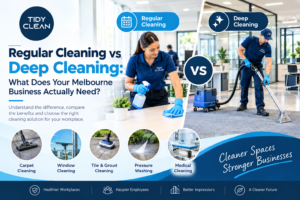
- Carpet extraction — hot water extraction lifts embedded soil that vacuuming cannot. Most Melbourne offices need commercial carpet cleaning every 6–12 months, sooner for ground-floor tenancies near street entrances.
- Window cleaning — internal and external glass, quarterly for most offices. Melbourne’s westerly dust and construction activity in the growth corridors makes this more frequent than owners expect. Window cleaning is almost always priced as a separate visit.
- Hard floor care — strip and seal vinyl, buff or polish sealed timber and stone.
- Tile and grout restoration — bathroom and kitchen grout lines discolour regardless of daily mopping.
- Exterior pressure washing — entryways, footpaths and car park bays, typically twice a year.
How often should each area be cleaned? A quick reference
| Area | Small office (under 15 staff) | Medium office (15–50 staff) | High-traffic or client-facing |
| Bathrooms | 3× per week | Daily | Daily + midday check |
| Kitchen and breakout | 3× per week | Daily | Daily + midday check |
| Vacuuming (traffic areas) | 2–3× per week | Daily | Daily |
| Full vacuum (under desks) | Weekly | Weekly | 2× per week |
| Reception and entry glass | Weekly | 2–3× per week | Daily |
| Carpet extraction | Annually | Every 6–9 months | Every 6 months |
| Internal and external windows | 2× per year | Quarterly | Quarterly |
Use this as a starting point, then adjust for your actual occupancy days. Frequency, not hourly rate, is the single biggest driver of what you pay — which is worth reading alongside our breakdown of commercial cleaning costs in Melbourne before you sign anything.
Common office cleaning mistakes to avoid
- Agreeing to a scope verbally. If it is not written and attached to the agreement, it is not a task.
- Paying for five nights when the office is empty two of them. Match the roster to the days people actually attend.
- Leaving periodic works out of the annual budget. Carpet and windows then get deferred until they are a restoration job rather than a maintenance one.
- No sign-off record. A simple nightly sign-off sheet or app log ends most “was it done?” arguments in one week.
- Ignoring the loading dock, stairwells and end-of-trip facilities. They are rarely in the original scope and are always noticed once they are dirty.
- Buying on hourly rate alone. A cheaper hourly rate with fewer hours on site is not cheaper.
- Never reviewing the checklist. Offices reconfigure. A scope written for a 2023 floorplan will not match a 2026 one.
Why Melbourne businesses choose us for office cleaning
- Over 10 years cleaning offices, medical suites, childcare centres and hotels across Melbourne
- Fully insured, police-checked cleaners — the same team on your site each visit
- Written scope of works attached to every agreement, with a nightly sign-off record
- After-hours and early-morning scheduling so cleaning never interrupts your business
- Eco-friendly products safe for shared workspaces and sensitive environments
- Free on-site walkthrough and a fixed quote before you commit — no lock-in pressure
- Trusted by 500+ Melbourne businesses, with reviews you can read on our Tidy Clean Google profile
Our team is based in Tarneit and services offices across Melbourne’s west, north, inner suburbs and CBD, with periodic works including tile and grout restoration handled by the same crew that does your nightly clean.
Get your office cleaning scope right the first time
A checklist costs you nothing and prevents almost every problem businesses have with their cleaners. Take the daily, weekly and monthly lists above, adjust the frequency to your occupancy, and make it an attachment to whatever agreement you sign.
If you would rather have it done for you, we will walk your site, build the scope with you, and quote it line by line. Call 0404 352 582 or book your free quote today.